
Three recommendations for democratic reform in BC
BC wants to make its electoral system better. That’s why the Special Committee on Democratic and Electoral Reform will be making recommendations on democratic engagement and provincial voting models.
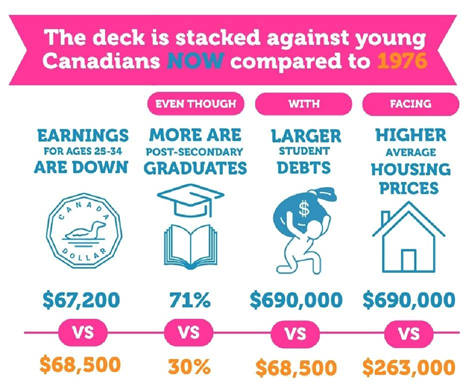
This is great news, because we know that BC’s public policy choices are failing generations of younger people. The symptoms are all around us: rising poverty, stagnant wages, increasing student debt, unaffordable homes, delays starting families, growing mental ill health, and widening age gaps in happiness and hopefulness. Decisions that made sense decades ago no longer meet today’s needs. This mismatch is fueling growing uncertainty, precarity and economic risk for too many young people, stoking generational tensions and resentment.
The erosion of our generational social contract is reflected in young people’s beliefs that the system is rigged against them, and that politicians are more concerned to promote the interests of older generations than building security for those who follow. These trends don’t bode well for the strength and vitality of our democracy. Not only do they go hand in hand with lower levels of voter turn-out among younger demographics, but they also reflect growing disillusionment in the idea that political institutions are capable of solving today’s problems – and therefore deserve our trust and engagement. Such cynicism puts at risk the collective action we need to address problems that can’t be fixed by individuals acting alone.
Fortunately, there are steps we can take to address these risks. Alongside allied organizations concerned to rejuvenate our democracy – like Vote16, Fair Vote Canada, Samara Centre for Democracy, and Apathy is Boring – Gen Squeeze provided 3 recommendations to the Special Committee.
We’re calling on BC to:
1. Require all political parties to provide detailed, costed platforms within 2 weeks of a provincial election call
We live in an information economy, yet political parties are offering voters less and less of it. Respect for voters begins with honesty and transparency about what’s being offered, what it costs, and who will pay. That’s how British Columbians can assess whether commitments are genuine, not just rhetoric that grabs headlines but leaves voters in the dark. Following the evidence means grounding decisions in data – not the latest poll or wedge issue. When policy proposals are grounded in evidence, voters are better equipped to hold governments to account, and governments are better equipped to speak with authenticity about their plans and challenges to achieving important provincial goals.
On behalf of all British Columbians, here is the minimum that the Special Committee should expect all parties to deliver in each provincial election:
- A Policy Platform
All parties should be required to deliver a detailed platform document no more than two weeks after an election is called. A policy platform is not a broad set of broad principles, nor is it a collection of high-level statements pointing out what’s not working, but failing to propose alternatives. A policy platform is a thorough, careful, detailed accounting of how a party understands current issues, what measures a party will undertake to address them, and how the party will balance the resulting trade-offs.
- A Costing Table
Responsible platforms must include a detailed tally of the cost of each proposed action. This applies to both new or expanded services, and cuts to current commitments. Many cuts have a cost, especially when they reduce revenue. Cutting taxes, for example, leaves future governments with fewer resources to fund services on which Canadians rely.
2. Lower the voting age to 16 in municipal and provincial elections
Decisions made today have a profound effect on the future young people will inherit. Since it’s clear that their wellbeing is already falling behind, younger generations need a greater say in our political processes.
BC spends more to support older than younger residents, a trend replicated in jurisdictions across Canada. This spending imbalance persists despite the deteriorating wellbeing of younger people. Compared to earlier generations, they struggle with higher costs, stagnant wages, and face larger student, public and climate debts.
Lowering the voting age to 16 would strengthen young people’s voice in BC’s electoral and political processes, empowering them to make their voices and votes heard at a time when so many markers of their wellbeing are declining. Since too many of our public policy systems are failing to do enough to address the challenges faced by these demographics, a lower voting age would help to ensure that the interests and needs of young people are better reflected in political, policy and budget decision-making. Politics responds to those who organize and show up – but right now, there is little cost to elected officials when they privilege the interests of older votes over young people who are unable to vote at all.
Research from 17 countries with a voting age of 16 confirms the feasibility of a lower voter age, debunking misconceptions around judgement and maturity, and demonstrating that changing the voting age can strengthen civic participation. A range of global and Canadian studies have found that 16- and 17-year-olds are not less politically developed than adults. In some cases, they are more knowledgeable or as knowledgeable as adults. Similarly, Elections Canada has found that those aged 16-17 are just as interested (and sometimes more) in participating in various forms of political activity, including both voting and non-electoral civic activities.
BC should take this timely opportunity to become a leader in Canada on empowering young people in provincial political processes. We can be better ancestors to those who follow us by giving them a voice in decisions that will deeply affect their futures.
3. Make progress on designing a new electoral system over the next 3 years
In key moments like elections, it is especially critical to make sure that all British Columbians have an opportunity to make their voices heard. Our current first-past-the-post system does not deliver adequately on this goal. BC needs to move towards a proportional representation approach, in which seats in the legislature more closely reflect the popular vote, and each party's supporters are fairly represented in every region of the province.
A strong majority of Canadians already back the principle of proportional representation. Many of the strongest democracies around the world use proportional representation electoral systems. Now is the time for BC to once again take a leadership role on this issue in our province.
The Special Committee can deliver on this goal by setting out a process to move BC towards a new approach for elections that empowers all residents to help elect a representative who shares their values, and reflects the true diversity of political opinion across the province. In designing these next steps, we strongly urge careful consideration of the measures outlined in the submission from Fair Vote Canada.
Download our full submission to the Special Committee on Democratic and Electoral Reform